The German hospital sector faces major challenges: Demographic change is altering healthcare needs; the growing shortage of skilled workers is driving up costs and placing a strain on staff; and structural reforms require modern, cross-sector care models. Against this backdrop, the question arises as to how hospitals can be positioned for the future and how this can be financed—and this is precisely where the Hospital Transformation Fund (KHTF) comes in.
The Hospital Transformation Fund supports investments in the transformation of hospital care and, in doing so, pursues four key objectives:
Important: Unlike the KHZG, the KHTF is not a funding program for digital infrastructure or solutions. These may be required in specific funding cases to enable implementation. At its core, however, the program focuses on structural changes. The funded project is therefore always, first and foremost, a structural project—with digital processes serving as a supplementary component where appropriate.
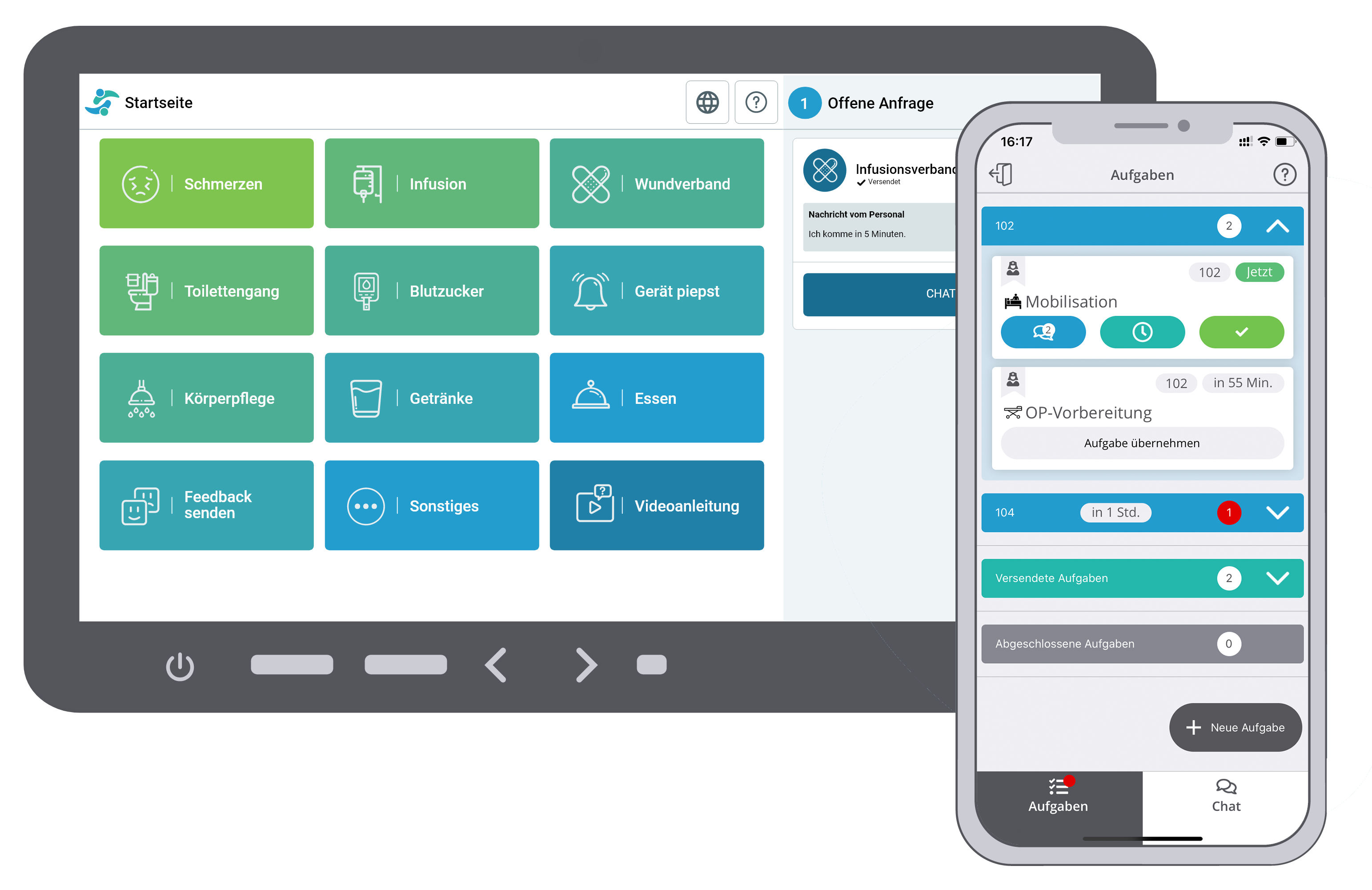
The KHTF comprises eight funding categories—Cliniserve supports you with three of them through its digital nursing process platform, Cliniserve CARE. As a digital nursing process platform, Cliniserve optimizes internal processes and enables new staff scheduling processes. Within the framework of the KHTF, Cliniserve primarily enables a higher caseload through the optimal use of existing personnel and structural resources. This allows for the concentration of services, both organizationally and in terms of staffing. At the same time, Cliniserve CARE is already integrated into telemedicine models and enables their integration into acute care.
Important: The states decide on the applications and their structure and are looking for comprehensive projects.
Scope of Funding:
The Role of Cliniserve CARE:
Due to increased case volumes at the receiving facility, additional capacity is needed—which is often created more efficiently through process improvements than through structural or staffing expansions. Cliniserve CARE automates the assignment of tasks to the appropriately qualified person and reduces delays through transparent process updates (e.g., advance notification during transport). Overall, this enables higher utilization of the clinic’s capacity while optimizing staff utilization.
Scope of Funding:
The Role of Cliniserve CARE:
Cliniserve enables the clinic to achieve higher overall utilization through optimized staffing and more efficient processes—the foundation for handling more cases and more complex treatments at the center. As a platform that can be integrated into the existing IT landscape via open interfaces, Cliniserve CARE also supports the project’s required interoperability.
Scope of Funding:
The Role of Cliniserve CARE:
As a shared platform, Cliniserve CARE establishes a uniform working framework across all participating locations and improves process efficiency. It also supports the required harmonization of the IT infrastructure within the network. Thanks to its modular, scalable design, the platform can be rolled out gradually at all network locations.
We were frequently asked about this last year. However, the requirements are more complex than anticipated: There must be five hospitals, including a university hospital or a maximum-care facility serving as the coordinator—and all must operate within the same networked system. Therefore, in our view, this funding criterion is not currently intended primarily for acute care processes. Nevertheless, Cliniserve has been supporting telemedicine approaches in acute care for several years now as part of the WELCOME research project, and with CARE, it ensures the integration of these approaches into acute care. So please feel free to contact us with any project ideas.
The KHTF offers you the opportunity to make your hospital structures future-proof. Cliniserve CARE is the digital solution that supports the successful operational implementation of your projects under funding categories FTB 1, FTB 4, and FTB 5. With Cliniserve, you can build the capacity you need to provide high-quality care with adequate staffing levels.
We'd be happy to discuss how we can support your project.
Get in touch now!
Phone: +49 8924418274
Email: info@cliniserve.de
Website: www.cliniserve.de